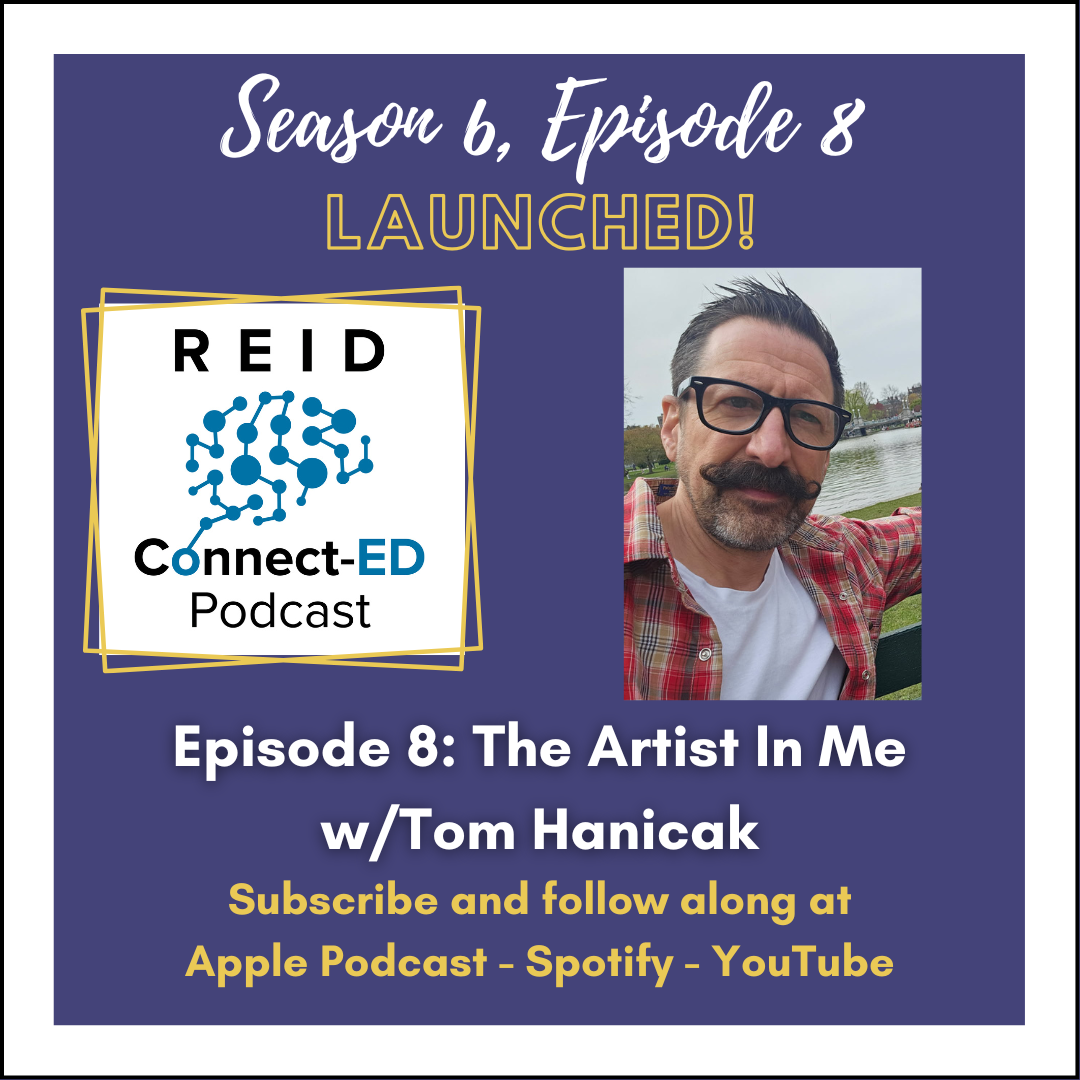
S6 E8: The Artist In Me w/Tom Hanicak
Listen Now!
-
TOM HANICAK
Established over a 25-year career steeped in education (administrator, psychologist, instructor, facilitator), social services (art therapist) and art (filmmaker, painter, illustrator, musician).
Currently, as an educational consultant, who leads school districts with systemic plan implementation that includes but is not limited to technical assistance and coaching with: assessment, data analysis, curriculum design with an emphasis on special education and universal design for learning. Tom worked as the art therapist providing individual and group therapy for adults and children living in emergency shelters and has honed his skills at holding space for and sharing loving kindness for those he encounters.
Always creating, whether it be painting, drawing, sketching, playing, or creating, Tom leads his life through art while integrating creativity into all aspects of his work and life- You can find current: visual notes and art at vasenhouse.com and Instagram: @thomassey71
-
Tom talks about coming to terms with what it means to be an artist having grown up with others in his life who did not understand the ‘artist in him’, leading him to put the ‘artist in the backseat’. Now, he feels completely fulfilled to embrace his identity as an artist.
Alexis shares how ‘success’ can mean different things to different people even though other people can try to define what ‘success’ means for someone.
Tom talked about being on a college preparatory track in high school without even having an art class, despite constantly making things as a kid… making things out of class, restitching sneakers, etc.
Tom talked about how this creative part of him was suppressed.
Gerald shares how there are many kids growing up who appear to be ‘successful’ on the surface but are struggling on the inside.
Tom talked about how he did not feel pressure to perform academically but he always felt there was something he needed to do with the creative part of himself. He describes how he’s always let his curiosity define his learning.
Tom talked about being encouraged to go to college by his advisor despite not knowing what he wanted to do and not performing very well in a traditional sense of grades. He shared how he had an incredible philosophy professor who saw his potential in class discussions, asking Tom “where are you going to grad school?” even though that was a foreign concept to Tom.
Gerald and Alexis share how important curiosity is in terms of growing and blossoming in a career by way of diving deep into understanding and genuinely experiencing aspects of the work/career.
Tom talked about first enjoying school when he started studying art therapy.
Tom described how he has always felt things very deeply as a child and even today. This was something others did not understand and appreciate. For Tom, this was the sensitive nature of him, which he began to channel into his career as an art therapist. He felt art therapy was a combination of how he is as a person and using art as a way to express that and utilize that.
Tom believes that every person has an innate need to create. The innate need may vary. He thinks of it like a faucet - some people’s creativity drips; some can control the faucet. He describes how his ‘faucet’ flows with water all the time. He describes how others in his life wanted to control the faucet. Tom shares how he feels so deeply it brings him to tears experiencing artwork and listening to a symphony as a child. He describes it as ‘beauty running through me’. Over his lifetime, he’s learned that he is not ‘broken’, as certain societal constructs and expectations would suggest; but it’s actually a beautiful thing he is this way.
Gerald and Tom share how emotion can oftentimes be felt without words. Tom shares how oftentimes ‘words fail me’ but showing art is when he feels genuinely seen and understood. This is an art therapy principle, as well. People in society are so good at censoring words; however, in art, there is authenticity and rawness comes out. Gerald shares how important this is for therapy - no filter, just honesty.
Tom shares how art that is created is an ‘extension of us’. “What is inside is now out,” allowing people to have a conversation with that art. Tom shares how powerful this can be in a therapeutic setting. He shares how sometimes clients would see something they created and want to throw it out; however, Tom allows this reaction to be explored with the client. This allows the client to actually have a conversation with themselves.
Gerald shares how important art expression is in the context of how difficult it can be to express oneself verbally. Communicating what is going on inside can be difficult to understand or explain; it can even be unconscious.
There are different ways of understanding the meaning of behavior. Tom interprets an example that Alexis brings up of a child ripping up a piece of paper as a representation of ‘undoing’. Tom goes on to share the meaning of ‘undoing’ in arts and creation; as in, some sculptors reduce and subtract rather than build, while others do the opposite and mold something in an additive process.Tom suggests behaviors can be explored in this way.
Tom shares how inviting clients to make art puts them in a very vulnerable space and so the relationship is so important. Tom creates an environment where there is no pressure.
Alexis shares how important it is for her to help her clients (learners) to get comfortable with the process of creating something with the larger context that what is created can evolve and be refined over time.
Tom shares how he has helped clients create something with the intention of letting it go; particularly when trauma has happened, and when there are things people hold onto that have been harmful and/or no longer serves them.
Tom shares how people can see things differently and feel things differently.
Gerald shares how important it is for therapists to ask patients what they take away from therapy sessions. It may be different than what the therapist thinks it was; or even if it’s the same it may be understood or described in a unique or different way. Alexis shares how when you walk away from an experience that there is such a different way that the same experience is experienced by different people, making it so important to ask questions and be curious about.
Tom describes how art can be the purest way of conveying a message. And yet each viewer will get a different representation and interpretation of what that is.
Tom shares how he feels like he belongs in a room of art.
Gerald shares how connection is very much an emotional experience beyond intellectualization.
Gerald shares how important any therapy revolves around working through emotions when people truly transform in their therapy process (emotion-focused therapy). Art seems to be an excellent way to access those deeper and complex emotions. It can be difficult to know what to do with our emotions without an outlet or modality like art.
Alexis shares how important it is in learning to make the internal more external and how art is a direct line to that.
Tom also shares how sharing art is an important part of the therapeutic process to give it a place to live outside of himself and interact with the world, which he feels like changed him.
He shares how social media can be a great platform to share art within a community of artists.
Gerald shares that perhaps the more a person integrates their art into their sense of self perhaps it becomes a natural progression to share it.
Tom shares how there can be gender stereotypes of feeling emotions, despite emotions being such an integral part of creativity. This can lead a person to creating a ‘false-self’ and feeling misunderstood by others and even by himself. He had to learn how to embrace his emotional side.
Gerald shares how common it is for patients to require time, attention, and exploration to express in an authentic and accurate way how they feel.
Gerald shares how amazing it is that Tom transformed the challenges he faced early in life into helping others in a deep way.
Gerald shares how important it is for different types of people to exist in this world so that different types of goodness can come in different forms. Tom shares how art can be so impactful and powerful in a positive way.
Tom shares how Abraham Maslow used the word ‘horticulturist’ for the adults in children’s life who can cultivate and nourish the flower that they are and to feel appreciated for who we are rather than forced into being something we are not. He shares how that is very much the philosophy of how he worked with clients in art therapy.
Tom and Gerald share how structures and rigidity can stifle creativity.
Tom shares a quote by Prince about how powerful it is to create something that has never existed before.
-
Music.
Alexis Reid 00:09
Welcome back to the ReidConnect-ED Podcast. In my world, I'm fortunate to connect with people who not only inspire me through the work they do, but somehow also help to brighten my own light for the occasions when this happens, there seems to be a direct line from their energy to mine, even if we don't see each other for years, that spark pops back up instantaneously with each connection today, we're joined by one of those people who both challenges me to tap into my own creative side, while also amplifying the passions we both share around art, music, education, mental health and creativity. Today, we're joined by an incredibly talented artist, musician, therapist, educator, creative and all around great human I met Tom years ago through our shared passion for creating educational access and greater understanding of learner variability, I think at a cast event or UDL symposium, I think all of the lines are kind of blurred over the past few years, but it's been a while, and we've connected several times since, through national faculty meetings, through cast trainings, and most recently, just trading pleasantries and points of inspiration digitally for The past few years, from the first time we connected, we talked music, education, mental health, art and so much more. And over the years, I've been a fan of his work, and in our first encounter, we had one of those powerful experiences where we immediately knew we would collaborate in some way. So today is likely the beginning of those collaborations to come, and Tom Hanicak is here in the studio today all the way from Cleveland, Ohio, and we're so grateful to share this experience of having him join us for the Reid connected podcast. Tom Hanicak established over 25 year career steeped in education as an administrator, psychologist, instructor, facilitator and social services as an art therapist and art as a filmmaker, painter, Illustrator, musician, and so much more as an educational consultant. Tom leads school districts with systematic plan implementation that includes, but is not limited to technical assistance and coaching, with assessment, data analysis, curriculum design with an emphasis on special education and Universal Design for Learning. Tom worked as an art therapist, providing individual and group therapy for adults and children living in emergencies shelters, and has honed his skills at holding space for and sharing loving kindness for those he encounters, always creating, whether it be painting, drawing, sketching, playing, or any other aspect of creation in work and life, you can find Tom and his current work and visual notes in art at vassen house.com, or on Instagram at Thomas Massie 71 Tom. Thanks so much for being here
Tom Hanicak 03:13
with us. Super glad to be here. Yeah, it's always, it's always, uh interesting when you sit, sit quietly while somebody like lists these things that you've done in your life. So thank you. It's very gracious, and I appreciate the invite and glad to be here. This is great.
Gerald Reid 03:30
Tom, we, all three of us, have had some amazing conversations last night at the wonderful beehive restaurant with jazz music and today at the thinking cup, and right now, as I'm sitting here getting ready for this episode and to talk to you, I feel like I'm, like, going into, like, a big game in sports, and I have to, like, calm myself down and, like, refocus my energy into being in the moment, because there's so many amazing things we've talked about, and I'm just so Excited to jump in here with
04:01
you. Yeah, thanks. Looking forward to it. So,
Alexis Reid 04:04
Tom, let's kind of start broadly. This is a question that sometimes throws people off, but we've, we've prepped a little bit around it. You know, I think that you're, for me, your primary identity, for me, when I think of you, is as an artist. And I wonder if you can share a little bit about your journey in becoming an artist, in being an artist, embodying everything that comes along with being an artist. So
Tom Hanicak 04:29
I can't describe how good it is to feel someone say that they primarily know me as an artist, because it's, it's who I am, like, like, through and through, and yet, it's something that the vast majority of people in the world don't know me as, because I essentially spent most of my life not letting that the core part of. Who I am guide the decisions that I make. You know, like, I, I've used the the analogy before, where, when I talk about, like, being an artist, and I'm in my 50s now, and,
Gerald Reid 05:16
like,
Tom Hanicak 05:18
it's fairly recent that I've decided, like, if you, if you can imagine, like driving a car somewhere, it's fairly recent that I've allowed the artist in me to be at the steering wheel, to decide how fast to go, how hard to push on the acceleration pedal, and when to hit the brake, when to turn, where to turn, for most of my life. I mean, the artist is always there. Has always been there, but he's been in a back seat, or at times, been in the trunk, just because of life. I think, you know, there was a lot of, there's a lot of coming terms with, like, what is an artist? Because I didn't grow up around artists like I grew up around people that wanted good for me, that wanted me to be successful, that didn't understand that there are artists in the world that are successful, and that doesn't mean they're successful in, like, all the traditional ways. So for me, it was like, you know, you've got to go to school, you've got to get a good job, you've got to, you know, like, not be an artist, you know. So, so, yeah, so, so exciting for me to hear that like that. You can see like. You use see me as like. That's primary, because it's been a while. Yeah,
Alexis Reid 06:48
it's so interesting. And in your role as educator too, right? I see that that we have so many different layers to who we are as we show up in the world. And you know, as we were promoting universal design for learning and helping support educators understand that. You know, we talk a lot about what success means, like, what is this version of success that especially young people who are trying to figure out their lives and go through the motions, and even now, as we're older, we're trying to figure it out each day, too. You know, we hold on to these ideas of what success might mean. And success is like, in my mind, so fleeting and hard to capture. It's like running water, right? Like, you can feel successful in a moment, then all of a sudden it's gone, and you're like, off to thinking about or doing something else. But this idea of success sometimes I think can and can really isolate and push down these parts of ourselves that sometimes are just like screaming to come alive,
Tom Hanicak 07:49
yeah, yeah, no. I mean, as you're talking, I'm thinking like, I went to good schools, or what was, what we would be considered good schools, and was on what was called, like a college preparatory track in high school, and never once took an art class. Wow. So, like, how does that happen? Yeah, and here's the thing is, like, I've been making art since I can remember, like I was digging in the backyard, digging up clay to make little sculptures when I was little. Like I had to make things all the time. I as a teenager, would, I would, I would, I had a paper route, so I saved money, and I would go and I would buy, um, generic tennis shoes, but I would buy two pairs, and I would come home and undo all the stitching, Oh, wow. And I would add my own stitching. Like, I just did this independently. Like, so cool. And nobody, like, again, nobody in my world was like, well, this kid has got something that he needs to do. Let's ask him about it, or let's channel it in a way that fits, fits somewhere. But like, I was in school and, and, and, and, you know, was on what would the college prep track and performing miserably? I mean, like, miserably, like I as a sophomore had like a 1.3 grade point average, just not a good student. And, but yet, doing all these, like creative things independently, because they didn't fit anywhere in school, and so, like, I had no idea what I was gonna do. And this is where, like, that whole artist thing is, like that, that's the artist who's unstitching tennis shoes as a teenager, trying desperately to say, Can I drive the car and make some decisions, but having no guidance to, you know, to figure that out. Yeah, I
Alexis Reid 09:44
think this idea of like, what traditional success, or, you know, collegiate prep looks like, where, you know, there's a lot of other people making decisions for young people to say, this is where things need to go and be. And I think that, you know, and we hear these terms. Lot in media, but it really comes from mental health and psychology, thinking about how there's a lot of masking going on to kind of just fit in the path or the box that is expected of us, of people. And
Gerald Reid 10:12
there's plenty, there's plenty of kids. We see it all the time, kids who are on the on the surface, like on paper, quote, unquote, successful, and they're struggling on the inside with all this pressure that is, as you would say, in their backpacks. Well, you know,
Tom Hanicak 10:27
I'll tell you this far as, like, the pressure thing for me, I've, for whatever reason, school and learning. For me, like, I didn't like getting bad grades. I'm not like, you know, a rebellious like getting bad grades for the sake of it. But I never really cared like that I needed to get. So I know there are some students that are like, like, I need to get a 4.0 grade point. Like I need to get in the best colleges. Like, for me, I could care less, but I knew that there was something I needed to do, and at a certain level, like what mattered for learning, for me was in learning. I was just and I still am. I'm, like, curious about everything, and so I've always let my curiosity, and I think that's also a part of the artist in me, is like I let my curiosity define my my like, I would take classes and be like, I had zero interest in this, and I would go through the motions, but then, yeah, so, so like, yeah, success, what it looks like. I think back to when I was young, especially like in high school and college, and think, how do people know already what they want to be like? I, to me, that seems so I don't, I don't understand that I can appreciate it with like, when you see like the the Tiger Woods, it's like, I'm, I'm born to be a golfer, or you see people that like, they just know. I don't know how that happens, but I didn't. I just didn't. And so I kind of fumbled through, and I got into college on a letter of recommendation. Essentially, I had a school counselor say, I remember meeting with him as like a senior and I wasn't getting into college, and he said, you need to, you should go to college. Tom like, trust me. And I'm like, Oh, how do you how do you get in with this kind of grade point average or whatever? And he's like, we'll get you in. And then you'll make the best out of it. You'll figure it out, but you need to get in there. I had the same experience as an undergrad. I had, I wasn't the best undergrad student, but I had a professor say, Where are you going to grad school? Just after a class. He actually during the class, he said, can I talk to you after class? I thought it was like I had this, like mapping in my brain, like I was in trouble or something like, Why does he want to talk to me after class? What did I do anyway? It was actually very discussion oriented class. And then afterwards, I went up to him, and he just his line in was, where are you going to grad school? I didn't even know what that meant, yeah. I didn't, I didn't even know what that meant, yeah, but he saw, like, he saw something in me, relative to, you know, how I think, and I think that curiosity, more than anything, is just,
Alexis Reid 13:24
yeah, I was gonna say you mentioned that you weren't a good student. But in this might be controversial, but I have to say it, I would trade straight A's over curiosity in a learner any day, right? Because, you know, forget about, you know, fitting in the box and checking off the boxes as you go to have a curiosity about things you're experiencing and seeing and interactions you're having. I think that's what life is about. So
Tom Hanicak 13:49
I think that's why, that's why we get along. Yeah, no, I agree. Like, yeah, yeah. I wish, wish that were a metric for success in school per se, and maybe it isn't. Some schools. It's an area of focus. It just wasn't in mine. It
Gerald Reid 14:11
also allows you to do whatever you do in the long term as an adult, really, really well when you're curious, because you dive into it, you understand it. You know, you can't, I mean, you can do things in your career, but to truly understand it and to experience it, and our conversations, you clearly experience the things you're doing within your professions. It's a you embody it, right? Which is what great, you know, beautiful, amazing things come from that more than anything
Alexis Reid 14:39
I'm thinking about, you know, my initial statement of, like, I see you as an artist. And it's interesting, because I think anybody who creates can be an artist. And we had my meditation teacher on, fez was here, and we were talking about how we think that everybody kind of just shows up in the world with a. Spark of something inside of them, and what we do with it, how we amplify and tune that over time, through experiences, through explorations, through curiosity, is kind of what that journey and path is about. And to your point, thinking about art and being a creative and an artist, I think we all show up with some of that curiosity and spark of creativity that through different interactions and experiences. And I wonder if we can go back in time and talk a little bit about, you know, what your educational path was, because I think that both might have tried to snuff out that spark of creativity and artistic exploration early on, and then it also planted some really deep seeds that started to grow and flourish. And I think you know, for the listeners out there in the audience and anybody of any age, just to remember that sometimes creative exploration can give us life, can give us excitement, can give us an opportunity to express ourselves in ways we might not have even known we were talking before about a student I work with who was ripping things up, and we were talking about, like, what that could possibly mean and how that can look, and I have my hypotheses and and you named it, you put like A label to it that became an artistic creation, whereas somebody else looking at that experience might have seen it completely different, Yep,
Tom Hanicak 16:27
yeah, the process like so, so to, I think this I can, I can kind of attach, sort of going back before going forward here. So, so I, I, I first sort of felt good about school in college when I found studying art therapy so like, for me, like I go and went to college, I didn't know what I was going to do, but I've always been like a like, I've always been someone who just felt very deeply, especially for like, humanness and like the I was the kid. My mom would bring us downtown in Cleveland. The day after Thanksgiving. It was like this big thing where people would come downtown, and every year she would give us a couple dollars. So I'm one of five kids give us a couple dollars to buy something special for ourselves. And my mom tells me this story. I but I remember it. I there was this, this homeless man with without legs, who set up on a piece of cardboard in front of a Woolworth's on in Cleveland, downtown, Cleveland, and every year I would give my money to him. So I've always had this like, like, from I was very young, like others need to be taken care of. So I've always been, been, been caring and, like, wanting to help at people. And then, like, there's this artist to me. So I went to college, and I'm started to take art classes, and it was in heaven for the like, I'm taking these studio art classes for three hours, and it's like, it's like a blip of time, just thoroughly heaven, like. And then I found this art therapy area of study where it was like a combination of like, who I am as a person and how I relate to others, and then using art as a as a means to relate and connect. And so back to the creativity point that you're making, one of the core foundational elements of the field of art therapy is, is, is believing, and I believe this, which is why, like the field was something i i The work is something I did for so long and loved. Is, is every person has an innate need to create. We all do. You have to believe that. And I believe it at my core. It's just everybody's innate need varies. So, like some, I like to think about it like a faucet. So some people's creativity, it sort of drips, maybe, or they turn the faucet and they have control over how much they create or when they create, and they're really capable of doing that. My faucet is broke in a beautiful way. It just flows all the time. I didn't know that. I didn't have the wisdom to know that when I was younger, that it could be a beautiful thing, that it flows all the time. So if we continue with that faucet, thing is, I think thing people in my life wanted me to fix the faucet. They wanted me to have control over it. And sometimes when it poured, I was difficult to be around, because, because I did weird things, like, I like, so, for example, like, I feel art. Like, just talking about right now, I can feel it. I went to the art museum yesterday in Boston, beautiful. I've never left an art museum without tears in my eyes. Like, I feel it. You said that about the symphony too? Yeah? Well, I Yeah, as a child. Child. I went to see the Cleveland Orchestra in Cleveland, and they were tuning their instruments, and I just started crying. And I was child, it was probably like, eight at the time, and I didn't know what that meant. And it was, it was scary actually, because it was like, I'm looking around, like, why am I the only person in this space that is like, and I'm sobbing, like, literally, like, I'm not just sniffling and not in a bad way, but you're in it for everyone around me. It was a bad thing. But how did it feel? Oh, my. Like, actually, it felt, it felt, it was like beauty running through me. Yeah, right, exactly. This is that faucet thing. Again. It was like, I was, I thought I was broken, and I like, it's taken me most of my life to come to a point of being like, no, that's actually a beautiful thing, yeah. But in our world, I think there's so many constructs. There's so much expectation. There's so much what is normal, you know, so much perception of of who people should be. What back to that success conversation that we don't sit and like, like, look at a situation like that and think there's something beautiful happening here we apply. This is the label like we are, like a default to label things and an emotion typically is something that makes people uncomfortable and
Gerald Reid 21:35
Tom your experience is, in some ways, without words,
Tom Hanicak 21:43
absolutely, yeah, well, you know, during in so many ways to this, like, even now I I feel like my words are always failing me, when I when I show my art, I am all good. Like, like, when I show my art and I see people interact with it, I just feel a sense of like they see me because, because, and that's another art therapy thing. Like, I know that art bypasses all the nonsense. So, like, we want to talk psychology, like we're really good at censoring our words, like, especially as you get older, you get really skilled at being able to frame things in a certain way. When you make art, there are no sensors. Wow, that's you don't, you don't. It's pure, like primary process from like, a psychology terminology, it's primary process. It's like, pure aid, almost like, it's like, oh, it's like,
Gerald Reid 22:45
what you are aiming for in a therapy session is just, be honest, just have no filter. Like, that's, yeah, ultimately, that's exactly right, pinnacle of therapy. So,
Tom Hanicak 22:52
so as an art therapist, when I sit with people and I ask them to make art, I know it's super powerful in the with respect to I'm getting them in their most honest, raw and then sometimes they'll make art, and they'll look at it and they'll see themselves in like, they'll have an awareness, and it scares them, because it's like they're looking at themselves outside of themselves. Yeah, say more about that? Yeah. Like, well, so another core tenet of art therapy is like everything we make is an extension of of us, like tangible what was inside is now out, and we can then have a conversation with it. So from a therapeutic perspective, I actually, I, I don't know quite how therapists don't use art because, because it's like, you can have entirely honest conversations with like you make something and then let's talk about it, so you can be talking about you through something that's outside of you, and and, and it's Very, very powerful. And and I, I've shared this story before, but I many times in my career as an art therapist, I I've had clients that have made something, and they look at it and they say, this is I hate this. And they'll rip they'll want to rip it up, or they want to throw it out. And I always would, would, of course, say, you know that's you've made it so you are in charge of it. You get to do whatever you want with that. There's no wrong here. We can, we can do whatever you need to do with what you've made. But let's, let's, let's, kind of, let's, let's talk about it. Let's have a conversation with it. Even sometimes, sometimes people will make art, and I'll say, What? What do you want to say to it. And that's really me saying, What do you want to say to yourself now that's outside of you, like you're looking in a mirror. What do you want to what do you see? What do you want to say? And, and, and then there's the the maybe the extension of that it still needs to go in the garbage like, I hate it still. It's I hate it because they're uncomfortable. So. Yeah, and, and as an art therapist, as a human like, I care for people. And so every time that would ever happen, I would say this with the most open heart, I would say, if it belongs in the garbage and you need to put it there, that's okay. But I would, I would never, I would never put you in the garbage and and just saying that, I mean talking when you talk about what a therapist can do to be all in with someone who feels like they're ugly, feels like they don't belong, feels like they belong in the garbage. It's a very powerful thing to say to some No, you don't. No, you don't belong in the garbage for right now, if that piece of artwork needs to go there, and it's symbolic, let's talk about that, because undoing sometimes artwork needs to be ripped up Tom,
Gerald Reid 25:56
what you're saying is really, really, really meaningful in the context of how we express what's going on inside of ourselves is not always so explicit, verbal clear to other people, and this is like a really, really deep, important thing in terms of understanding therapy, understanding development, understanding behavior, that there it's a way of communicating what's going on in the inside, which is very complicated sometimes, to be able to convey and unconscious, even things that we don't Want to say or share come out. That's right. And, you know, Alexis, to your point, your example is such a great example to bring to Tom about the kid ripping up the paper and how they're on the one hand, you said, you know, like that could be interpreted as like a negative behavior or a distracted behavior, or an off task kid and Tom and you were so thoughtful to share what is the meaning of the ripping and go, maybe you can say more you know about that, as opposed to, like, let's just fix the behavior.
Tom Hanicak 27:14
So if I could jump in, as soon as we talked about this, I said he's just undoing. That's all he's doing. And, and we all do it, we we we undo, to redo. And so maybe he doesn't quite know how to redo. Yeah, and like, from an art perspective, this is, this is, again, is an example of like I see as an artist, I see and feel the world differently. And I, I immediately, when you when you mentioned that, I thought of a sculptor who who starts with a block of marble, and some some sculptors reduce, they subtract. There's the process of taking the block and finding a a bust of a face in the block. They can see it before they start chipping away at it. But then there are also some artists who actually do the exact opposite process, where they throw clay on top of clay, and then they form it and they feel it, and they have to mold it in an additive process, rather than a subtractive process. Both are important totally and so like undoing sometimes is a great way to say you need to do that. Let's have a conversation about bringing those pieces back together in an additive way, and let's look at it that way from a creative perspective. I'm just
Alexis Reid 28:33
thinking about there's so many things bubbling up for me right now. I'm going to try to organize and prioritize my thoughts. But you know, as you're just talking about this and I'm thinking about one of the most important developmental time periods, right adolescence, where our brain starts pruning, right and thinking about undoing. How powerful? How powerful is that, that our brains and bodies are undoing to redo without us even having to have conscious thought to do that. It's wild. So for the audience, you know, during adolescence, oftentimes we have these different hormonal shifts, we have all these big behaviors, and our brains are actually pruning back the neural connections that aren't getting used as frequently, and they're strengthening the ones that are used more frequently. So this is why, just as a quick aside, you know, it's so important to establish good behaviors during this time period, because those habits carry with us, and as we get older, it's harder to undo those habits because they're more solidified. But I was just thinking about this idea of pruning, of taking apart to put back together again. And you know what you said before, is just so striking, and I'm sure it resonates with other people, because it really just hit me thinking about a client or a person sitting with you, first of all, the fact that they feel comfortable enough to create art with you, if they don't see themselves, if it was hard for you to see. Yourself as an artist. Imagine somebody who has no previous experience creating in a most vulnerable state in those moments, and maybe that's why therapists don't use art so much, because maybe they're not comfortable with it themselves.
Tom Hanicak 30:12
Yeah, probably, yeah, probably. And no, no doubt, like to ask somebody to make art is, is? It's, puts them in a very vulnerable space. Yeah. So that's one of those things about being an art therapist that you have to approach that therapeutic relationship in a really like and this is something that I learned over time, that I think, because I'm an artist and I don't value certain art over other art, that I can sit down with anybody and say, let's just create together, and there's no pressure, like, I don't and I think I just kind of exude that. It's like, let's just, let's just make some stuff. You know what? I mean? Yeah, and that's you're right. That is not an easy thing to ask somebody to do, but it's, it's easy for me to do,
Alexis Reid 31:09
yeah? Well, I think, like, I think you set the table, yeah, yeah. And you invite folks in to say, let's create together. And
Tom Hanicak 31:17
this. So this is where, like, when I see art teachers, for example, I think a lot of our teachers have that they just, they just, they can, they can create a space where creativity can, can flourish, and they don't recognize exactly how they're doing it, but they have this sort of intuitive Like, respect for the energy, yeah, that creativity thrives on. Well,
Alexis Reid 31:43
I want to go back to the point you said, too in thinking about how a lot of times clients might say, I want to put this in the garbage, and it's an extension of their their own reflection or identity that they're holding on to for themselves in those moments. And this is an intentional emphasis piggybacking on what you just said about, you know, creating and establishing the energy to bring people in to create. I think it's so important for us to practice just putting it out there and saying, Oh, this doesn't fit me right now, or this doesn't maybe look the way I want it to. It's not expressing exactly
Gerald Reid 32:21
what I'm trying to communicate. And when
Alexis Reid 32:24
you were talking before, I have a client that I'm working with, and there's a huge transformation going on in her life, and she's an older woman and and I for whoever, for whatever it's worth, I realized that 2025, in the Chinese calendar is the year of the snake. And the symbolism there is that this year is meant for us to shed our skin. So, as you were saying, like these folks who want to, you know, throw their art, which is an extension of themselves, in the garbage, can we actually celebrate that and say, hey, yeah, you know, there's nothing bad about this. No, no, no, but maybe we need to create a new version of whatever you're trying to express here. How beautiful is that? You know? Yeah,
Tom Hanicak 33:10
absolutely. And so this is, this is another like thing that I would do often as an art therapist. Is so like to create something with the intention of letting it go. Oh, yeah. So like something I would do, and I did this in domestic violence shelters, a lot families, women who fleeing abusive relationships and children do this all the time. When things go go bad is they think it's their fault, like they've done something that caused it, yeah. And so what I like to do is to intentionally create things that need to be let go of, and so make them tangible, something like and, and, and I would, of course, this is something I would describe prior to like, this is the intention. Because sometimes burying like, we would actually like, ceremonially like, sometimes find a place to bury them, to make like a representation of something that just needed to be put somewhere away. Released, just released. Or we would make something, and we would form a circle, and we would, I had this big coffee can that had a big Phoenix on it cool. And the process was, is to burn it and drop, like, to write something and you could share it, or you could just keep it to yourself, but then to burn it and just, like, feel it go away. Yeah. So, like, so, like, like, yes, what you make is a part of you, but sometimes there are parts of you you need to let go of. Yes, they're not serving you any longer. And sometimes they're they're things that you you believed in yourself because of what other people I mean I could this is like a self reflection, like I for my lifetime. I'm, I'm an artist, and people didn't know what that meant, and I sort of denied that self like that doesn't serve me. Yeah, it doesn't serve me any longer. So sometimes things need to let go, and that's okay, that's that's okay.
Alexis Reid 35:15
It's interesting. You know, we keep bringing up this idea of people don't know what an artist is. And I think it's true, yeah, you know, I think people will see like a symbol of what art or artists might be, yeah, but to really understand and appreciate your full embodied experience, I think it's difficult for people to really understand that,
Tom Hanicak 35:37
yeah. Well, again, I've given a couple examples, like the shoe stitching, the being crying, sobbing at the orchestra. Here's another thing is, like, I when I was young, I still get excited about beautiful thing. I like, I see things that other people don't see, and it sounds I just do. I like it, whether it's color or but like, I remember when I was younger, I saw the sun when it sets on a clear night, the blue and the orange yellow of the setting sun create a line of green in the sky. And I remember when I, like, when I was younger, I could see this green, and I would get excited about it. And I actually remember doing like a sort of like a diorama for a class, like a social studies history class as an elementary student, and I made sure that the green was in the sunset of the diorama. And I had teachers say, like, skies aren't green. No, they are. So I was the kid that was like, what? And so, like, on a very literal level, I was being told that what you're seeing isn't true. And like, like, wait a second, here I was seeing stuff that excited me. Yeah. And instead of being like, and again, this teacher clearly didn't see the green, and I'm just gonna go put it out there. And for people that listen to this, I would ask yourself to think about that as a metaphor as well. Like, some people see things that you don't, and it excites them, and you don't see it. It doesn't mean there's something wrong with either of you. It's just we see things differently, like, feel things differently. You
Gerald Reid 37:20
know, it's funny Tom, it's like similar. What you're saying is, I always suggest that the students that are doing their internship always ask what the patient's taking away from your work with them, because you'll be surprised sometimes, yeah, and like, oh, oh, okay, oh, that's the part that really stuck with you, that you're holding on in your heart. And it may even be the same thing that you thought it was, but they're describing it in a different way, or in a different frame or a different like perspective, and it's like that's really important to be able to understand. I
Alexis Reid 37:52
gotta give props, because a few years ago, pre pandemic, that shall not be named, I ran a high school group, and all of these students would come in together, and there were a couple that were really musically inclined, one who plays a lot of instruments, who Jerry also knows, and they wrote a song about what their takeaways were, about what they learned from the executive function. And I wish they had it to share, but the recording somehow got lost. It was the coolest thing, because, you know, takeaways, as engaged as people can be in an experience, when you walk away from it, you step into a different zone, a different role, a different experience, a different anything, right so even us right here, right now, we might all walk out of this booth and have something else we're taking. We'll each have a different experience, even though we're here. Even though we're here in the shared experience. So So going back to the idea of being curious, and how much I value curiosity, and I am frequently saying this to parents and educators, especially, but especially to young people that I work with, regardless of their age, that this idea of being curious, asking these questions like you said, Jer, you know, checking in and be like, hey, what resonates for you? What are you taking away? What did you hear or see or feel in this experience? Because it might be completely different. I say this to educators all the time. I'm sure in your consulting role, you might also that what your goal is for what you want the students to take away might be completely different than what they're walking away with, yeah, and that's actually okay, as long as you have them reflect on that to the journey, right? Oh my gosh, yeah, ask those questions. Don't make those assumptions, because, you know, you just saying the green and the sunset. That's not where my eye focus is, but now that you said it, I can see it, yep,
Tom Hanicak 39:48
yeah. And so, like a minute ago, when I said, I feel. I feel when people look at my art. So this is a good example of when I say something that. Green in the sky. Thing allows me to say, to help people to understand that my art is a better representation of me than my words. Like,
Gerald Reid 40:14
like, look through my eyes. Yeah, what it looks like,
Tom Hanicak 40:16
yeah, yeah, like, like, or, this is, this is, this is what's inside of me, outside of me with no sensors and no like work to try to articulate it through language. Yeah, it's just pure Yeah. Whatever art I make, I just like to me. And here's the thing is, like, this is the amazing thing about art, is like art has multitudes of messages. So like, the viewer, every viewer is going to get a different a different interpretation of me. Yeah, of what's inside of me in its purest form, I when I show my art, the vast majority of people like, there are trends like, I listen to people. I love having conversations with people when they look at my art, the thing that I get most is it's moody, that there's like a heaviness to it. And I'm like, Okay. Like, to me, I'm like, Okay, awesome. There are other people that that talk about seeing glimmers of hope, and I have a whole notebook of write them down. People say things and because I love hearing what they have to say, because it's so it's varies so much. The common theme for moody is there, I would say at least 60% of people say that, and I'm totally comfortable with it. Love when people say it reminds me of this. Because to me, like Curiosity is all about context. It's always about, like, reminds me of this, yeah, and I love that, you know, like, if something I make reminds you of something, yeah,
Gerald Reid 41:54
the connection that's all good with you, yeah,
Tom Hanicak 41:56
like something human in me, yeah, raw in me, you can relate to, like, how awesome that's the is there what's more beautiful than that? And we don't even have to talk, it's just like, there's this and there's, I think that's another reason why I feel art, like there's a room at the Cleveland Museum of Art, like I go in it, and it like, it's when people talk about going to church. And I grew up in the I grew up Catholic, so like, churches hold a lot of like people feel connected to their god in churches or whatever religion art museums are. Like church for me, like they like I feel, I feel like I'm sitting with with people like me, is it, you know? And it just makes me it talk about belonging. I feel, I don't know how this is going to come across here, but I feel like I belong in a room of art more than I belong in a room of people. I think that's
Alexis Reid 43:01
I think that's true for a lot of people sometimes, but they don't always acknowledge or recognize it, so they spend a lot of their time trying to fit into these spaces that they don't always feel comfortable in.
Tom Hanicak 43:12
That's like people trying to be a version that is okay, yeah, and maybe in service of others or so to me, i That's why, like, I feel like I'm, yeah, like I'm, I'm with raw form, like I'm with the real stuff. How beautiful
Alexis Reid 43:31
is that?
Gerald Reid 43:32
I mean, any type of connection is, is emotional, it's deeper than intellectual, right? It's not, it
Tom Hanicak 43:39
bypasses all that stuff that our brain? Well, it's all in our brain, because this is the only thing people say they feel in their heart, you know, like when I put it out there, our brain is all connected. It's all connected. But isn't it wild that we like connect our chest and our heart with emotion when it comes from our head?
Gerald Reid 44:00
And then, you know, the counseling theories class and like the all the classes we teach in the end about therapy is, like, one of the common denominators of any type of therapy you're using is really gotta access and and and dive into and be with, help the person to be with, and bring into the room the emotions. Without that, it's really just kind of an intellectual exercise, which is not bad, right? There's nothing bad about, you know, exploring understanding, getting insight and all that stuff, but, but anything deeper in transformation that happens in therapy, in life, right? Is an emotional experience which, which, you know what you're sharing about art is a wonderful representation of a way to access that, a way to to explore that with someone. It's just
Alexis Reid 44:50
incredible. I was thinking when you were talking earlier, that there's something I often say in my work around executive function, which comes from. Um, ancient philosophy and religion, spirituality. You can connect it to Buddhism. It's, you know, how do we make the things that are internal external, right? And, you know, there's a whole lineage of this as an exploration, but I think art and creativity is a direct line to that right, finding what's internal to bring it to life in an external, more concrete way. But to your point, Jerry, if we just hold on to all these emotions, you know, our brains and bodies don't always know what to do with that. And to have this extension of art and creativity, I think is, I'm gonna call it a tool, but it's so much more than that, yeah,
Tom Hanicak 45:40
well, and you mentioned this a little bit earlier, because there is, there is the act of sharing it too, that is, that is. And we talked about this a bit last night, about like, performing music, for example. Like when I, when I started showing my paintings, it changed my paintings. When you start performing music, it changes your music. Yeah. So like, and say more about that, yeah. So that's actually something that, like, I mean, I haven't been sharing my art like, for most of my life. Like, I'm, like, I said, I'm in my 50s. I didn't start sharing my art until, like, I was mid 40s.
Gerald Reid 46:18
I didn't start sharing my music until two years ago. I'm 40 now, so,
Tom Hanicak 46:23
so and now that I share my art, whether it's music or filmmaking or or paintings, I'm, I'm just much. I'm just much more creative. And it, I know how to describe it. It's, it's like, it's, it's making, it serves, serves a purpose. And that's all well and good. And for for all those artists in the world, who, who, that's all they need. No judgment for me, I get it. I get it. But I would say to anybody who's making is to put yourself out in the world through what you've made and and let it live like, it's, it's, it's now, like, and going back to the therapy conversation, I know it's hard because, like, sometimes you make something, you look at it, you're like, I don't know that it's ready to be in the world and and like we can swim in that metaphor and extend it all day, but it needs to live. And when you give it a life outside of yourself, yeah, it changes you. And so I'm gonna just say about I'm gonna speak just for myself. I sound like I'm a therapist, like talking about you, and I really, I'll talk about me. When I started sharing my art, it, it was, it just felt, it felt like it was just giving it its own life, you know, and it changed me. And that's part of like the drive the artist driving the vehicle like he's he's driving the car, deciding how fast to go. A part of the decision to drive the car was my art needs to live outside of me and interact with the world. And even if you're someone who just posts to Instagram like their paintings or whatever, or their their music, and just, that's an that's a really good example of, like, you can do that. Yeah, I'm not a big social media person, but, like, Instagram is great for a community of artists, and it's a great opportunity to say, here's my art, and it's a, I mean, Instagram is a fairly safe community of artists, and I can say that because I've, I've connected with a lot of artists all over the world, in fact, and there's a community of artists that are, you know, they're out there. And, like, I really believe that, like, what you have to offer, and maybe this is because I've been, I held on to it for so long and I didn't understand it, and maybe I wish I would have understood it sooner. Is that it it takes on its own.
Gerald Reid 49:09
It's more integrated into your yourself, yeah, I wonder that this is the natural progression. The more you integrate it into your being, the more it naturally comes out as well. Yeah,
Tom Hanicak 49:19
absolutely. Yeah. I mean, it changes. It's a different it's a it's a next step that it just again, my words are failing me. It's like it just gives it a life that it deserves. Speaking of
Alexis Reid 49:35
visuals, I have a visual my mind combining both of the metaphors of, you know the artist in the trunk, and then the the faucet overflowing. I'm like visualizing the artist in the trunk just overflowing with water. Yeah, right. And I think that you know the way you're describing things, it's almost like, over time you release the water and you move to a different position. Yeah? Yeah, where you can kind of channel and hone and direct where the water goes. Instead of let it just flooding you and not knowing what to do, I'm letting
Tom Hanicak 50:09
people swim in it though. I think, I think if I extend that metaphor like my Fauci has been full bore for my life, yeah, so it's filled up. It's filled a it's filled a body of water. Yeah, that I'm, I've been the only one swimming in,
Alexis Reid 50:27
oh gosh, I I'm not, like, seeing you feeling and visuals like I'm picturing like a young Tom, like, feeling like you were just trapped under this water, that you saw the beauty in it, but didn't know what to do.
Tom Hanicak 50:42
I thought I was like, I just didn't. I didn't understand any of it, honestly, like I didn't, especially its relationship to emotion. Because as a boy, emotion is not a thing that boys are like, it's a when I grew up, it was a it's a weakness. And to me, they're hand in hand, creativity and emotion. They're like siblings. Like you two are super close siblings. They're like the closest siblings for me, so like, I like, so I was shamed with my creativity and the emotion related to it was, like, it was yeah, I didn't know, and I had the faucet that was just just broken, yeah, and so, like, that's why I I thought it was broken, because I felt broken. Oh,
Alexis Reid 51:33
could have felt suffocating, yeah. Well, I
Tom Hanicak 51:36
yeah, I Yeah. It's so you say suffocating, and I pause, because I never felt suffocating. I just always felt overwhelmed. Like, why isn't anybody listening? Yeah, you know, like, I always felt misunderstood, even in my own self, like and like, I've gone down this rabbit hole with, like, becoming a psychologist is, like, you know, the notion of false self. Like, sometimes people have to develop a something that that is cons, you know, that's a psychological term to say sometimes people develop a self that fits. You know, I my creativity, that faucet so strong that that like I could as much as I tried to create that self, false self, it wouldn't allow it like it wouldn't allow like it's it was just more powerful. And what
Gerald Reid 52:39
you're describing is like, it's a people describe this in therapy, like, when they're talking about how they feel, they're describing it like, you are, like, I feel like I can't move, like I want to do this, but something's stopping me. It's like, it's like they're, they're describing an illustration, actually, with their words. You, you have done such an incredible thing with your life that is so inspirational for other people, to go through something hard and painful and confusing and to channel it, not only to evolve into being yourself more fully, but You've given back and contributed in an incredible way that you have become almost like a mirror for people to do the same for themselves. Feel like a lot of therapy is some ways reflecting back someone to appreciate themselves for who they are, and if anyone is listening to appreciate differences among people's personalities and ways of being in this world is that I think if there's goodness to bring about in this world, there has to be different types of people to bring about different types of goodness in different types of
Tom Hanicak 53:56
ways. I agree, and I would go, I would add to that to say that artists change the world. Artists have the power like, art changes the world. I agree. We just have to let it like, and this is where, like, I think of all these artists, these young people in the world that maybe are afraid to put themselves out there in the world, I'd say, like, just do it. Like, let let it, let it out into the world. Yeah, yeah. We talked about so much, Jerry, when you were saying, like, that different types. It made me think of that Maslow conversation we had is, and when you say me growing up, how I felt, and I said overwhelmed, and that sense of belonging is that Maslow language behind he talks about how parents and teachers and therapists are like a trifecta of impactful people in the lives of young people. For example, or anybody at any age. And he talks about the idea of them being like horticulturists. So if you think about a role, your role as a parent, or your role as a therapist or your role as a teacher, as being a horticulturist, what does that mean? Like someone who takes care of plants, plants, horticulture is they like, just cultivates flowers and makes them beautiful as healthy flowers. And he he uses that and says, You need to embrace being a horticulturist, to make roses into the most beautiful roses, and not to make roses into lilies and and Alexis and I have talked about this is like, when I heard that, I'm like, That's so beautiful. We need to stop doubling down on trying to make flowers into different flowers that we like or prefer and and I think that's why I was so successful as an art therapist. It's like, I just would work with kids, and I just, I loved the Okay, array of wildflowers. Like, to me, like, that's just, I just loved it. And I love interacting with people to help them to see the flower that they are, yeah, and then we can make it the most healthy, beautiful flower, but they don't even know what flower they are, yeah? And to me, like, I think about that, and I'm like, What flower I think I'm a peony. Actually. I think those are gorgeous, yeah, but like, like that as well gifted us that. And I think that's a life that's a life principle, yeah, that like we so desperately need, like we can't try to shape like these beautiful, these beautiful flowers, and try to make them into what they're not. And so, like, as a child, like, I didn't know I didn't I don't know that. Like, if we continue this metaphor, that anyone in my life was a hortic, actually, my dad was a gardener. But like, applying it to like, supporting humans to become, I didn't have horticulturists in my life, and schools. And the world is about sorting and about defining and fitting in. And it's, it's, it's very, it's very, you know, it's very difficult to know that there's all these, there's just this beauty in the world that's being compressed and not cultivated. And so, like, I mean, as an artist, like I, I am in a position right now where I love and actually do this at my work, as a as an educator, I work in the field of education mostly, and when I, if I've ever, ever like in a meeting where we're introducing ourselves to one another, I now introduce myself. My name is Tom Hanna, check, and I'm an artist and a musician and and I lead with that, like it's, it's I lead with that no matter where I'm at. Um, it's I, it's important, like and to the artists in the world, yeah, um, lead with that. It's so
Gerald Reid 58:09
funny, Alex, maybe you're thinking the same thing last night. We're walking back after we had dinner. Alexis and I were walking through Boston, and Alexis is pointing out these beautiful tulips, daffodils, daffodils and tulips. And she's like, look how beautiful they are. And she's like, You know what, they're going to be gone in a few days, or, like, in a short period, appreciate them. They're going to go away. And I think to your point, we were appreciating how beautiful they were, and we were also like, you know, kind of sad that they're going to go
Alexis Reid 58:39
away. Call them fake out flowers.
Gerald Reid 58:43
But it just kind of in my mind, I'm like, Well, you know what? Like, those flowers are not there to serve us. Oh yes, that they are there to exist for their sake of what they are and and you're appreciating what they what, you know, what you appreciate about them. But they're, they're just there. They're gonna grow and they're gonna I love natural. Course, I love
Tom Hanicak 59:02
to swim in metaphor. And so when you're talking about that, I love that perspective. And my my immediate connection to that was, there are also some trees that are blooming Right, right about now that stink that. And so, like, go back to the like children I worked with in my career as an art therapist is, like, sometimes kids stink and they're hard to be around physically, but that's part of the beauty. Yes, like, this is and so this is where I go as a human being. Like, I can't, I can't express to you how excited I am to find stink in humans and be okay and let them know it's okay. Like, this is what makes you you Yeah. And like, that's what that Yeah. That's yeah, yeah.
Alexis Reid 59:49
I am going back to what we were talking about yesterday in the flower metaphor. And Abraham Maslow is a humanistic psychologist who contributed so much to the world, but. Kind of got pushed into the business world of like, you need to follow this hierarchy to be successful, of course, going back to success. But Scott Barry Kaufman, who I really appreciate and admire so much, did a deep dive on Maslow's work, and has reinvigorated this idea of humanistic psychology in a really beautiful way. And it's a big part of the work I do, and I think it's also, again, Tom what connected us in our thinking about things. But I was thinking about myself as a flower when we were talking about this, and I said, I feel like I might have been when I was younger, at Daisy in a field of tulips, where maybe I was blooming and felt good, but didn't always feel just the same as everybody else. And now, as I'm thinking about it, as we're here talking, I'm like, I almost feel like my daisy turned into a Gerber Daisy, which might have turned into a sunflower, which I now, you know, thinking about peonies, that's like, my favorite flower, and they're so graceful and, like, subtle, yeah, but impactful. And I'm like, maybe that's my next form of transformation. And, you know, I think this goes back to just your whole story and thinking about how the artist has always been inside of you, but there's been all these different versions and expression, expressions and explorations of who you are, that's kind of brought you back to who you always were, and now you feel more comfortable and and settled and maybe safe in sharing that with the world. Yeah, and,
Tom Hanicak 1:01:30
and I feel safe because you've invited me here. So I want to acknowledge that is that you all have invited me here to feel safe, to communicate these things. So I'm grateful for that you're you're that we're in the garden conversation. I can't help but share a brief anecdote here. So one of the things I used to do all the time in my work as an art therapist in the shelters was this time of year, especially in the spring, is I would, I would ask for people to think about like, if you had a community garden and you put yourself into it, like, visually, like, What flower would you be? Or are you a butterfly that comes and helps fertilizer? Are you the sun like? So I would just completely open it up for like, like people to just own, like, how they could fit into the garden. And I would do it every year, and then we would actually go plant a community garden too. So they would pick so I would extend it into the actual like growing, which is with beautiful extension, but to have a group of young people who are in crisis or no longer in crisis, they're in a stable housing situation, and ask them to think about who they are and how they fit through their artistic expression. It's just so beautiful to watch and to see how they interacted and how they placed themselves in the garden relative to other plants in the garden, or if somebody was a snake. And I think about, there's this one year I did this, and there was a fan. There's a bunch of bunch of families with one family in particular had there were like five siblings, and one of the the oldest sibling was like a 13 year old teenage boy who just was very angry, like just he, he, he put only anger into the world, like he was either completely isolated, or when he was around people, it was like the stay away from me. I'll hurt you, kind of a vibe. And so as a therapist that that I don't stay away. I'm not, like, intrusive, but like, I would always, like, I still love doing this. I do miss do this is like, connecting with everyone, no matter
Alexis Reid 1:03:49
what they give me, having a class, yeah, no matter
Tom Hanicak 1:03:51
what they give me on a day to day, it's like, I'm gonna come because I care. Yeah, so I, I would do that. And so I did this group. And he was in the group this therapeutic activity to make these flowers and things for the community garden and a visual so we put, I put, like, large paper, like butcher black paper, on the wall, and it gave them tons of supplies. And then they would create their representation, and they would put it up into the environment. So they would create this visual community garden. And this particular boy was just, he was, he always come to my groups. It's like the only thing he would come to. And he was busy the whole time. And when it was time to put people's representations into the garden, he didn't, he didn't put his artwork up there. And I had built enough of a relationship rapport with the group that was in the house that I felt like it was okay to kind of push a little bit at that. And I'm like, I'm gonna give a fake I'll call him Jerry, because I'm looking at you. But his name wasn't Jerry, so for confidentiality purposes, I'd like Jerry. We didn't see your artwork in the garden. Like, you know, it's not a garden like everybody's. And he's like, I'm not, I'm not doing it. And I felt it was okay to press a little bit, and I said, I said, but if it's our garden and you're not there, then it's no longer our garden, because you're a part of us. And he just, he like, he could, he was simmering like his I could sense he was getting like, uncomfortable, yeah, because I really like, like, you belong with us. I was really communicating with him through the art that you belong like we care about you. And so this is when, like, group processes is awesome, because one of the other kids said, Yeah, Jerry, like, like, you're a part of the group. Put it up there, and I remember it. It's one of those, like, therapeutic interactions in my career that just locked in because it was so beautiful and and intense. But finally, after, like, reaching the level of frustration. He just said, you don't effing understand. And I said, What don't I understand? Great question. And he goes, You don't understand that if I put myself in that garden, it will poison everything. And he so he was communicating. He said, If I put myself, and then it so he was he was in communicating. He was letting the art communicate. But he was saying, I so he was, like, right on the bridge of knowing that that art was him, and he was able to say that. And I mean, like, how powerful is that?
Gerald Reid 1:06:43
One of the hardest things for people to share is their self hatred. Yeah, yeah.
Tom Hanicak 1:06:46
And, and this was the magic of the space, is the kids supported him. I didn't have to say word Wow. That's what I love about groups. The kids in the group saw that vulnerability and that self hatred, and said, No, you do. They're like, come on, it's okay. And his, what he made was this black thing, you know? I mean, it was like, and it stood out, like, as something that maybe wouldn't fit in a community garden, yeah? Like, that looked healthy. But when it went up there and we all looked at it, the group was like, This is awesome, yeah, you know, so, so, like, so, this is, like, one of those art therapy conversations. But then also the flower and like, like, cultivating people to be who they need to be.
Alexis Reid 1:07:32
It was into that to change over time too. Yeah, absolutely. And that's such a visual representation of seeing the change exactly seeing how, in the context, like we keep talking about of a community garden, that blackness might not have been as dark as he was seeing it,
Tom Hanicak 1:07:49
that's so powerful. Yeah, no. So, yeah. So, so, like, I love living in the the visuals, the like, visual representations and metaphors, to me are, like, I can live there, yeah. Well,
Alexis Reid 1:08:03
this is for another time, but acceptance, commitment, therapy does a lot of this metaphor visual work too, and thinking about the mindfulness presence aspect of it. But I love this idea and integration of integration is the word the integration, but also this additional layer of creative expression and bringing art into that work. So this is a plug for all the ACT therapists out there to think a little bit more creatively. I
Gerald Reid 1:08:28
think it's even beyond act. It's integration. You've integrated into a larger whole, it’s gestalt in many ways. And that's I'm not I'm not sure you would be able to have done that with him if you had not gone through what you went through to integrate yourself, within yourself and within your environment too.
Tom Hanicak 1:08:45
Yeah. No, I think, I think you're right. That's very much why I believe the field of art therapy is a space that I felt at home. Yeah, yeah. And I mentioned this to Alexis yesterday, like I, I resigned from my work as an art therapist a year ago. It was a point in my life where I'm like, okay, so it was really difficult to let go of, yeah, sure, yeah, but, but, but it'll actually, it was part of what putting the artist in the driver's seat required. Does that make sense? Yeah,
Alexis Reid 1:09:17
totally. I so there's two things. One is, I just want to appreciate and acknowledge what you shared with me yesterday too. Is that you said, in a very humble way, I am very good at holding space for people going through hard moments and sharing love through that work. And I really appreciated you sharing that because you know, in our careers and in our lives, sometimes we get to a point where we are actually really good at what we do, and it's hard for us to say that and acknowledge it. And I really appreciate it, like I feel it in my body, even just as I'm saying it now. And I really felt that then, because I feel similarly, and I feel like this is a purposeful. A blessing, kind of for me, at least outside of myself. That is just a really beautiful opportunity that I get to live every day. But I want to also, you know, pivot and I'm cognizant of the time, but would be remiss not to talk a little bit about what it means for you now to be an artist, what are some of the creative expressions? Because even though you're not technically an art therapist in role today, as you're describing your experience of how people interact with your art, it still is therapeutic, probably for you and those experiencing the art you create. So I wonder if you can share a little bit about what you've been working on, what you are working on, what inspires and excites you now.
Tom Hanicak 1:10:47
Yeah, so the transition from not, yes, I can't not be an art therapist like I'm sound like through my training and through them all my work, I kind of see the world that way, but I if, because that's not a primary job, it's shifted, like you mentioned, like bringing love to the work. And I want to emphasize that word, because when I was a younger clinician in talking about the work, I knew that I was bringing love, but I was afraid to call it that
Gerald Reid 1:11:24
real quick, I wrote a book by Nancy McWilliams about psychodynamic therapy, probably like some time during my training, and she used the word love in terms of what's happening within the context of therapy. And she described in a way, as you're saying, maybe not the way people think of the word love. It's not romantic love. It's not, you know, other types of love, but to see it written in a book, right? And to, I just want to point out that there are other people who can emphasize this is not just like one person, just bringing some random idea up. This is, like, a important, yeah,
Tom Hanicak 1:11:59
yeah. And I think, as a professional in the work of being a clinician, like you want to, you want to, like, write the notes the way that you're supposed to write the notes, and, like, you got to do the diagnostic like, there's a lot of like widgets to the work that that are important. But for me, they, they didn't allow me to communicate the authentic, authenticity of, like, No, this is about love, until, like, maybe 10 years ago, where I felt like I had all that stuff, and it was just intuitive for me to show up to work and do good work. So, like, 10 years, I think I just showed up, and that's what I just love. I just brought love, yeah, and, and they the the kids to be able to do group that I just described, like, Yeah, I'm a therapist. I have training, and I have skills, and I can kind of know how to push and pull and like, and, and, but it's really like, I just, I brought love, and I want to say that like, because it's important to the work of therapy, like you have to, I think, be okay with that. But when I stopped being an art therapist, I think that that I had to turn that inward, and I'm still working through that, yeah, but what it's done. I think, I think it is helped me to kind of do some self love, because for decades, I was giving it, and then when I stopped, I didn't know what to do with it, and I think I turned it inward. Now it's part of like, this artist driving the car. And so as far as my art, like I have no there are no rules for what I can and can't do, what mediums I can use in order to get what's inside of me on the outside. So, like this last summer, I I, I wrote and created a short film that's gonna hopefully screen at festivals this fall. We shot it last year. I reached out to great friends, great talented friends, and I said, I've got an idea. And, like, great friends do they said, well, like, let's do this. And so we shot a film, and I and it's something that I I've been wanting to do forever, and and now I can, yeah, but like, if I want to oil paint, oil paint, if I want to use acrylic, if I want to sculpt, if I, if I, whatever it is, there, like, there are no there's nothing, there's there's no wrong and so, like, like, I actually would like to say, because this is, like, this podcast format gives, gives us the opportunity to speak to people. As I would say, if you have things to make, if you are to make, if you have a need to make, like, get rid of the rules. Yeah, just, just do whatever it is that you need to do and put it out in the world. Let it. Outside of yourself. Yeah, just do it. Sometimes. That
Gerald Reid 1:15:04
makes the most amazing art actually, right? Like, people who go through music school, they're like, Okay, now I gotta, like, unlearn every all these rules I've learned so I can actually be creative again. Yeah,
Tom Hanicak 1:15:13
when I apply to art festivals, like to show they ask for the medium because you can't have, I don't have you ever gone to like, art festivals, but you'll see people's like, have booths or whatnot. I do a couple shows like that a year, because I like, I like that, but they, they, you have to choose your medium. And when I, when I do that, I'm like, What are we doing here? Like, this is an art festival. This goes back to the organization, but, like, but actually, like, I say I'm a painter, but I sneak other art into my booth, but actually I can get, like, in trouble for that. Like, did they have police that, like, make sure you stay within your medium. And, wow, and, and, and I just would say to people like, let, let the creativity flow at the pace, at the rate, let your faucet flow how it needs to, yeah, regardless of what people think, just allow it, yeah, yeah.
Gerald Reid 1:16:12
Don't you think, like most people who delve into creativity would say, you can't, like, force it to happen. It just kind of comes through you in these moments, right? And that's such a great advice for people to just like, let those moments move you and don't suppress it with, like, these rigid rules or structures.
Tom Hanicak 1:16:31
Yeah. And again, like Alexa said earlier, the creativity, whatever form it's getting what's inside outside. So whether it's writing, whether it's, it doesn't matter. It's like, that's, that's creativity. You're making some I want to make sure I get it right. I posted to Instagram recently. It's a it's a prince. Said this in an interview. He said that there's nothing more wonderful than putting something in the world that didn't exist before, like, like to put, like to create. There's nothing more amazing than creating something that didn't exist before. And like, every one of us can do that at any moment. Think about that. Like, think about how powerful it is. Yeah, you can put something into existence, even
Gerald Reid 1:17:19
to make a joke to someone is being creative, yeah,
Tom Hanicak 1:17:23
I just it's so, so beautiful, so powerful.
Alexis Reid 1:17:27
I was just thinking like, there, there's so many new studies now on, on, like mindfulness meditation, journaling, like these, these small moments that we can capture that becomes some kind of energetic expression. And whether you're walking down the street and notice a beautiful bloom or a smell or, you know, I think all of that is creativity, and how you interpret and perceive it can shift and change how you feel. You know, I asked probably the impossible question of, can you describe your art? And I'm so glad you shared the way you did, because I'm going to encourage folks that are listening to check out your art on your website and Instagram and follow along, and you know, be inspired, maybe just to capture a simple water color that can turn into something so much more. I need to ask one more question. There are a few characters I'll call them, who show up frequently in your work, and I want to give you a few moments to kind of talk a little bit about that. So when people are checking out your art, they have a little context, yeah, around these characters who show up. Yeah,
Tom Hanicak 1:18:44
so, so their themes and symbols. We all have them. And for me, I'm a landscape painter. Like landscapes are important to me. Being in nature and being in the wilderness is is peaceful to me, and I think there's nothing more beautiful than like an ominous storm. So that's a symbol for me, like clouds and storm clouds, also ravens and crows are a personal symbol for me that I've learned a lot about when I was in graduate school, part of my training as an art therapist is to was to really do a deep dive in understanding what symbols potentially can mean and how they what they mean to you, and why you're drawn to them, like the whole union collective unconscious of like we like if you're not the first person to feel A connection to a symbol in the world, because from the beginning of time. And so for me, like that character, like the Raven, had became a Ravens and crows, Blackbird specifically became personal symbols to me and and it wasn't till I was in graduate school in art therapy. Where I was asked to do a deep dive to try to understand it in in the deepest way, like, on a, like, a biology level, even like, like, what is it about ravens that makes them unique, unique animals in the world? But then also, what other cultures, stories, mythologies about ravens, like, and I learned so much like, I was going into like, I always was connect, felt a connection to ravens, but I associated it negatively. Like, like, we call a group of crows a murder crows, not a flock, they're a murder. There's a negative connotation. So I always thought, Oh, this is like, a representation of shadow self of somebody like, like, a part of me that I try to suppress and and, but the more research I did, the more like, like, the context just broadened, and I learned that so many cultures look at ravens and blackbirds as positive. I just did a residency in Alaska two years ago with the US Forest Service, where I was able to make art in in like with Forest Rangers, I went with them into parts of Alaska that people don't go to to make art. That's awesome and and they're beautiful ravens there and the tlink, the Tlingit tribe, Alaska Natives, the raven is, is the symbol that brings light to the world. Like, come on. We call a group of crows a murder. We think of Edgar, Allan Poe. We think about, like, that moodiness, yeah. And, but, but, like I, I opened my eyes to, like, a different cultures perception of a symbol, and it completely opens up my eyes. Like, wait a second here, yeah. Like, maybe this symbol, I'm connected to it because it brings light to the world, and not because it's ominous. And maybe I can bring light to the world through this connection. So like, when I when I would paint or draw ravens or black birds in the past, I would always like another reason, like, keep it to myself. It's like, this is, this is something maybe to not share. It's something that but, but I'm like, wait, wait a second here, this is another reason to share. Is like, you think that something means something, but, like, culturally, it can mean so many different things. So I would say to anybody, like, if you could feel connected to a symbol when here's another example, it doesn't. When I was in grad school, I was very fixated on images of the sun. So like this, this sun image was everywhere. And actually it was like a sun that was setting between, like mountains. And I just couldn't stop making it as sons and sons and sons. So things change, like, symbols change and like, I'm in grad school at the time, and I'm studying art therapy, and I had learned plenty in pursuing the symbol of the the Raven. So I'm like, looking at Sun, and you can go to young and look at like symbol, like cross cultures, historical meaning behind symbols, and come to figure out, like, at that exact same time my son was being born, I'm making all these sons and not realizing that son, a son, is a very father. It's a father symbol in so many cultures, like the whole Sun and Moon and a moon being the maternal, paternal like, so like, is not interesting. Like, I feel like I need to make all these sons right at the same time, I'm becoming a father for the first time, you know? And it's like, it's like we, I would say to anybody who feels drawn to something symbolically and not just even like, if you're not, if you're not, like, creating a representation of it, just if you're drawn to it, yeah, is to just kind of be curious. This goes back to the curious thing. Be curious about what it means to people outside of yourself about like history and mythology and like the world, because I think it's going to expand an awareness to self as well. Yeah. So yeah, that's the Raven. The Raven is landscapes, and ravens in particular are pretty strong symbol for me.
Alexis Reid 1:24:15
I love that. And you know, I when I go into classrooms and work with teachers and parents alike, I encourage them, obviously, to be curious and ask good questions of their students and children, but also to investigate and encourage the children to investigate. And I feel like this conversation here today, the past few hours we got to spend with you here in Boston, has been such a beautiful investigation of creativity, of art, of connection, of the power of learning and listening and just being, and I really appreciate it so much. And as Jerry said, You are truly a gift, and we are grateful to have you as a part of our life and now of the show. So thank you. Tom,
Tom Hanicak 1:24:58
yeah, thank you for. For inviting me and for creating a space where I feel safe and comfortable being an artist.
Gerald Reid 1:25:09
Thank you so much. Tom beautiful.
Thanks for tuning in to the Reid Connect-ED Podcast. Please remember that this is a podcast intended to educate and share ideas, but it is not a substitute for professional care that may be beneficial to you at different points of your life.
If you are in need of support please contact your primary care physician, local hospital, educational institution or support staff at your place of employment to seek out referrals for what may be most helpful for you. Ideas shared here have been shaped by many years of training, incredible mentors, research theory, evidence based practices and our work with individuals over the years, but it's not intended to represent opinions of those we work with or who we are affiliated with. The Reid Connect-ED Podcast is hosted by siblings Alexis Reid and Dr Gerald Reid. Original music is written and recorded by Gerald Reid. Editing and recording was done by Cyber Sound Studios. If you want to follow along on this journey with us, the Reid Connect-ED Podcast will be releasing new episodes every two weeks each season, so please subscribe for updates and notifications.
Feel free to also follow us on Instagram at ReidConnectedPodcast that's Reid Connect Ed Podcast and Twitter at ReidConnectEd. We are grateful for you joining us and look forward to future episodes. In the meanwhile, be curious, be open and be well.
In this episode, we are joined by Tom Hanicak - artist, educator, art therapist, and beyond - to discuss what it means to allow artistic expression to flow through us all. Tom shares his personal journey of not understanding his own creative energies as a child and ultimately finding his way into an art therapy program, in which he was able to harness and connect his passions for creative expression with his deep care for humanity and helping others.
Tom goes on to share his personal experiences with allowing the ‘artist in him’ to take the wheel and drive in his life, which is something that had been suppressed for so many years as a misunderstood youth and student. Gerald and Alexis bring in themes of mental health, psychotherapy, learning and education, and more, as this episode brings together so many pieces of the human experience, including individuality, community, and self-love.
Be curious. Be Open. Be well.
The Reid Connect-Ed Podcast is hosted by Siblings, educational therapist, Alexis Reid, M.A. and licensed psychologist, Dr. Gerald Reid, produced by CyberSound Recording Studios, and original music is written and recorded by www.Jerapy.com
*Please note that different practitioners may have different opinions- this is our perspective and is intended to educate you on what may be possible.